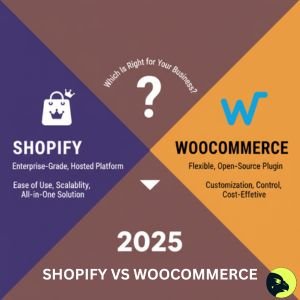
Running an online store in 2025 means making a smart choice of platform. Two popular options are Shopify vs WooCommerce. Each has strengths and drawbacks. In this article, I will explain both clearly, compare them in different ways, and help you decide which is best for your business in 2025.
What Are Shopify and WooCommerce?
Before comparing Shopify vs WooCommerce, let’s define them.
- Shopify is a hosted, all-in-one platform. This means Shopify gives you the website software, hosting, security, and support in one package. You don’t have to manage servers or much technical detail.
- WooCommerce is a WordPress plugin (add-on). You install WordPress on a hosting provider and then install WooCommerce to turn your site into an online store. You control hosting, themes, plugins, and everything else.
So, Shopify is like renting a ready-built shop, while WooCommerce is like building your shop on land you own.
Why Compare Shopify vs WooCommerce in 2025?
As technology improves, both platforms have evolved. In 2025, issues like performance, speed, security, cost, flexibility, and ease matter more than ever. A bad decision might slow your growth or make costs explode.
When choosing Shopify vs WooCommerce, we will look at:
- Ease of use
- Cost
- Customization & flexibility
- Themes and design
- Plugins, apps, and features
- Payment gateways & fees
- SEO (search engine optimization)
- Security & maintenance
- Scalability & growth
- Support & community
- Which is best for what kind of business
Let’s dive in.
1. Ease of Use
This is often the first thing beginners look at.
Shopify
With Shopify, you sign up and immediately get an admin dashboard. You fill in your store name, pick a theme, add products, set payments, and you can start selling. The interface is clean and guided. You don’t have to worry about hosting, installing software, or updates. Because it is hosted, the technical part is handled for you.
WooCommerce
WooCommerce runs inside WordPress. So first, you need to install WordPress, then add the WooCommerce plugin, pick a theme that is compatible, and configure your store settings. You also need to manage hosting, updates, backups, and plugin compatibility. So the learning curve is steeper.
In short: Shopify is much easier for non-technical people. WooCommerce gives more power — but you need to manage more things.
2. Cost (Which is Cheaper?)
Cost is very important, especially for new businesses.
Shopify Costs
With Shopify, you pay a monthly subscription. In 2025, plans typically start around $29 per month and go higher depending on features. Shopify includes hosting, security, and support in that fee. But you might also pay for premium themes or apps.
Also, Shopify may charge transaction fees if you use external payment gateways (not Shopify Payments).
WooCommerce Costs
WooCommerce itself is free (the plugin). But “free” does not mean zero cost. You must pay for:
- Web hosting
- Domain name
- Security (SSL certificate)
- Premium themes or templates
- Paid extensions/plugins
- Developer help (if you need it)
Because you choose your hosting and plugins, the cost can be as low or as high as you want. Some stores run cheaply; others with many features may cost more.
Many experts argue that WooCommerce can be cheaper in the long run if managed well.
Comparison
- Shopify gives predictable cost (you pay a fixed monthly fee, plus extras).
- WooCommerce gives unpredictable cost, but potential to spend less if you manage resources well.
- If you have many features or heavy traffic, premium hosting and plugins can push WooCommerce cost high.
So cost depends on your scale, needs, and how well you manage things.
3. Customization & Flexibility
How much can you change your store to fit your vision?
Shopify
Shopify has a template system and uses a language called Liquid for custom coding. You can customize themes and add apps (extensions). But some core parts, like checkout flow in lower plans, are limited. For deep changes, you may need Shopify’s higher plans or work with specialized developers.
You don’t get full access to server code or backend settings.
WooCommerce
WooCommerce gives full control, because it is open source. You can edit templates, use PHP, add custom code, override default behavior, and choose your host. You can build almost anything (as long as you know or hire someone who knows).
If you want a unique store design or special checkout logic, WooCommerce is more flexible.
So in Shopify vs WooCommerce, WooCommerce wins customization and flexibility hands down, while Shopify keeps things simpler but somewhat constrained.
4. Themes & Design (How Your Store Looks)
A good design attracts customers and builds trust.
Shopify
Shopify offers a good number of professional templates (themes). Many are mobile responsive. You can customize with a visual editor and drag-and-drop blocks. But heavy customization beyond what the theme allows may need coding.
Also, premium themes cost money.
WooCommerce
Because WooCommerce is built on WordPress, you have access to many themes (free and paid) in the WordPress ecosystem. You can use page builders like Elementor, Divi, or others to build or design layouts freely.
You have more design choices and more tools to shape your store.
So on design: WooCommerce gives more flexibility; Shopify gives ready templates and simplicity.
5. Plugins, Apps & Extra Features
Your store will need features like email, marketing, shipping, discounts, etc.
Shopify Apps
Shopify has a large app store. You can add many features easily by installing apps. They integrate well.
However, each app may cost extra, and too many apps can slow your store.
WooCommerce Plugins / Extensions
WooCommerce is part of WordPress, so besides WooCommerce extensions, you also can use many WordPress plugins. That gives a huge ecosystem. You can find plugins for almost anything: subscriptions, memberships, bookings, advanced shipping, etc.
The tradeoff: you must manage compatibility, updates, and conflicts.
So in Shopify vs WooCommerce for features and plugins: Shopify is simpler and safer, WooCommerce is more powerful but needs careful management.
6. Payment Gateways & Transaction Fees
How you accept money from customers is vital.
Shopify
Shopify supports many payment gateways. But if you use a gateway that is not Shopify Payments, Shopify may charge additional transaction fees (e.g., 0.5% to 2% depending on plan).
If you use Shopify Payments (available in many countries), transaction fees might be lower or none. But that depends on your region.
WooCommerce
WooCommerce does not charge its own transaction fees. You pay only what your payment gateway (like PayPal, Stripe, local gateway) charges.
So for many stores, WooCommerce has an advantage in reducing extra fees.
In summary: Shopify gives convenience but may include extra costs; WooCommerce gives you more control over payment costs.
7. SEO (Search Engine Optimization)
If you want people to find your store via Google, SEO is important.
Shopify SEO
Shopify offers built-in SEO tools: editable meta titles and descriptions, automatic sitemaps, clean URLs, SSL, etc. But some SEO tweaks are restricted.
In 2025, Shopify is improving SEO features further.
WooCommerce SEO
Because WooCommerce sits on WordPress, you can use WordPress SEO plugins like Yoast SEO or Rank Math, which give you deep control over meta data, schema, sitemaps, redirections, etc. This is often better for advanced SEO.
Also, you can fine-tune page speed, structure, and content more freely.
Many SEO experts argue WooCommerce has an edge in SEO when managed carefully.
In the contest Shopify vs WooCommerce for SEO, WooCommerce tends to win for those who want deep control. But Shopify is still quite good for basic to intermediate SEO.
8. Security & Maintenance
Your store must be safe and always working.
Shopify
As a hosted platform, Shopify handles security, patches, backups, and compliance (like PCI standards). That saves you worry.
WooCommerce
With WooCommerce, you are responsible for security, updates of WordPress, WooCommerce, plugins, backup, SSL certificate, and protection against hacks. This requires effort or paying for managed hosting.
So Shopify gives you passively good security; WooCommerce gives control but also responsibility.
9. Scalability & Growth
If your business grows, will your store cope?
Shopify
Shopify scales easily. Because it is hosted, it can handle traffic spikes, large inventories, and many sales without much setup. You upgrade your plan or infrastructure on Shopify’s side. In 2025 Shopify features like native B2B, markets pro, etc., make scaling better.
WooCommerce
WooCommerce also can scale well—but only if your hosting, architecture, caching, and optimization are strong. For big stores, you may need high-end servers, CDNs, load balancers, and expert development.
Thus, number of products or customers doesn’t limit WooCommerce; your infrastructure does.
So in scaling, Shopify gives you easier growth; WooCommerce gives you power if you invest properly.
10. Support & Community
When something breaks or you have a question, support matters.
Shopify
Shopify provides 24/7 support: chat, email, phone. Because they control the platform, they can offer direct help.
WooCommerce
WooCommerce has a large community, forums, documentation, tutorials, and many WordPress developers. But official direct support is limited compared to Shopify. You often rely on plugin authors or your developer.
So Shopify offers more immediate support; WooCommerce has community depth but more patchwork help.
11. Which Is Best for Which Business?
At this point, after comparing, let’s see which platform works best under what circumstances.
Choose Shopify if:
- You want to start quickly without technical hassles.
- You do not want to manage hosting, security, updates, backups.
- You prefer predictable, simple pricing.
- You want reliable support.
- You expect growth but want infrastructure handled for you.
Choose WooCommerce if:
- You are comfortable or have access to technical help (developer or hosting).
- You want full control over design, checkout, features, and code.
- You want to minimize transaction fees.
- You want to leverage WordPress tools, content, SEO, blog.
- You are okay managing security, updates, backups, and plugin compatibility.
So depending on your business size, budget, and skills, Shopify vs WooCommerce choice will differ.
Final Verdict: Shopify vs WooCommerce in 2025
There is no one-size-fits-all winner. Each platform shines in different areas. But here is a summary:
- Shopify is easier, safer, and more hands-off. It lets you focus on selling, not tech.
- WooCommerce is more flexible, potentially cheaper in fees, and gives full control. But you must manage the technical side.
If I were to choose for a beginner or a small business with limited technical support, I’d lean toward Shopify. If I were building a large store or customizing heavily, WooCommerce is more attractive.
Therefore, when deciding Shopify vs WooCommerce, think about your skills, resources, growth plans, and willingness to manage tech. That will guide you to the right platform for your business in 2025.